Attendance: A Bold, Playful Font for Real-World Impact
If you’ve ever stared at a blank t-shirt design, wrestled with a logo that feels too safe, or spent twenty minutes trying to make a workshop flyer stand out—Attendance might be the quiet solution you didn’t know you needed. It’s not another minimalist sans-serif or a nostalgic script. Attendance is a bold, playful font built for visibility, personality, and immediacy—designed to work where attention is scarce and authenticity matters.
What Attendance Actually Is (and What It Isn’t)
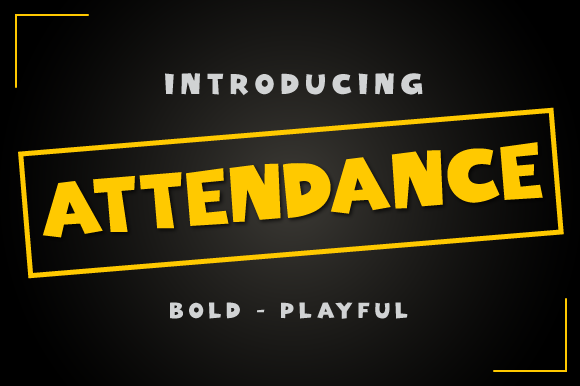
Attendance is a display typeface—meaning it shines at larger sizes, not body text. Its letters have generous spacing, confident curves, and subtle quirks: a slightly tilted ‘A’, a rounded ‘R’ tail, a friendly bounce in the lowercase ‘g’. It’s not handwritten—but it feels human. Not rigid—but never sloppy. It’s the kind of font you’d trust to represent a local coffee roaster, a summer camp poster, or the title slide of a TEDx talk given by a high school science teacher.
It’s not meant for legal disclaimers, academic journals, or multi-page reports. And it won’t solve branding problems on its own—but paired with thoughtful color, layout, and voice, Attendance helps ideas land faster and stick longer.
Where Attendance Fits Naturally—Not Just Where It *Could*
You don’t need a “font strategy” to use Attendance well. You just need a moment where clarity meets character. Here’s where people actually reach for it:
- Small business signage: A neighborhood bike shop uses Attendance for their chalkboard menu (“Tune-Ups • Rentals • Coffee”) because it reads clearly from across the street—and feels approachable, not corporate.
- Educational handouts: A middle school art teacher prints Attendance-based headers on project rubrics (“Your Vision • Your Process • Your Growth”). Students notice them. They remember them. The font quietly reinforces that creativity has weight.
- Event branding: A community garden’s annual “Harvest Fest” uses Attendance on banners, tote bags, and digital invites—not because it’s trendy, but because it balances energy and warmth without shouting.
- Personal creative projects: A freelance illustrator adds Attendance to the spine of their sketchbook cover, or uses it to label jars of handmade soap (“Lavender + Oat • Citrus + Sea Salt”). It’s a small detail that signals care and intention.
Why It Works Across So Many Roles—and Why That Matters
A marketer launching a wellness newsletter might choose Attendance for their “Subscribe” button—not to be flashy, but because it subtly communicates that this isn’t another cold, algorithm-driven email list. It says, We’re real people sharing real things.
A blogger documenting their zero-waste journey uses Attendance for Instagram story highlights (“Grocery Hacks”, “Mending Tips”, “Bulk Finder”). It gives consistency without stiffness—helping followers recognize her voice before they even read the words.
An educator building a classroom website drops Attendance into section headers like “This Week’s Challenges” or “Ask Me Anything Friday”. It doesn’t distract from the content—it makes the structure feel inviting, not bureaucratic.
The common thread? Attendance supports human connection, not just visual polish. It’s legible at a glance, expressive without overreaching, and flexible enough to adapt to tone—whether that’s upbeat, grounded, curious, or quietly confident.
Practical Things to Try Before You Commit
Before downloading or licensing Attendance, test it in your actual context—not just a font preview. Ask yourself:
- Will it scale? Try it at 48pt on a mobile screen and 120pt on a printed poster. Does it hold its shape? Does spacing tighten or loosen in ways that hurt readability?
- How does it pair? Attendance works best with clean, neutral companions—think a sturdy sans-serif (like Inter or Open Sans) for supporting text. Avoid pairing it with other bold or decorative fonts unless you’re intentionally creating contrast for a specific effect.
- Does it reflect your audience—not just your taste? A law firm’s pro bono clinic might use Attendance for a community workshop flyer (“Know Your Rights • Get Support • Ask Questions”) because it softens formality without sacrificing authority. But the same font would likely feel off on their official letterhead.
- Is the license right for your use? Some versions of Attendance include web, desktop, and app usage—others are limited. If you’re embedding it in a client’s WordPress site or a Shopify product page, double-check licensing terms. No one wants a surprise email from a foundry.
Real Outcomes—Not Just Aesthetic Wins
Using Attendance rarely leads to viral moments—but it often leads to quieter, more meaningful results:
- A freelance photographer saw a 30% increase in inquiries after switching her website’s “Book a Session” headline from Montserrat to Attendance. Her clients told her it “felt warmer, less transactional.”
- A public library’s teen summer reading program used Attendance on window decals and bookmarks. Staff noticed more kids stopping to read the titles—and more parents asking, “What’s this all about?”
- A food truck owner printed Attendance on reusable napkins (“Eat Local • Taste Better • Waste Less”). Customers started posting photos—not of the food, but of the napkins. The font became part of their brand’s casual, values-driven identity.
Final Thought: Fonts Are Tools, Not Magic
Attendance won’t fix unclear messaging, poor user experience, or inconsistent branding. But when your goal is to signal approachability, energy, or thoughtful presence—without leaning on clichés or overdesign—it’s a reliable, human-scaled tool. It’s the kind of font that works hardest when it doesn’t call attention to itself—just makes what you’re saying feel more worth hearing.
If you’re choosing a font for a t-shirt, a workshop banner, a podcast cover, or even the header on your personal portfolio, ask: Does this help people understand who I am—or what this is—before they’ve read a word? With Attendance, the answer is often yes.