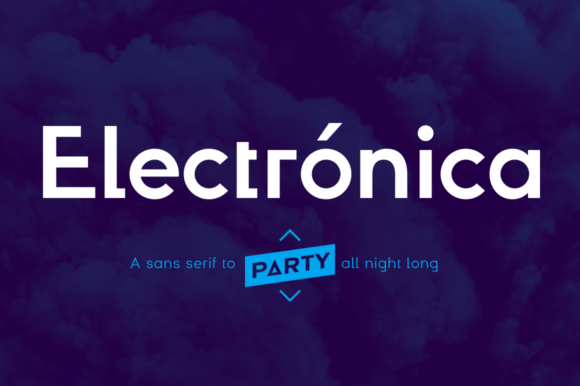
Electrónica Family: A Strategic Choice for Distinctive, Human-Centered Display Typography
Electrónica Family isn’t just another rounded sans serif. Designed in 2019 by Pablo Balcells for Graviton Font Foundry, it’s a deliberate response to a common design challenge: how to communicate energy, approachability, and clarity without sacrificing craft or legibility. Its 12 styles—including eight with small caps and broad multilingual glyph coverage—offer real flexibility. Four styles are freely available, lowering the barrier to thoughtful experimentation. But its value isn’t in quantity or accessibility alone. It lies in how precisely Electrónica Family aligns with specific communication goals—and how easily it can misfire when applied without intention.
Why Electrónica Family Fits Real-World Branding Decisions
When you’re choosing a typeface for a logo, headline, or product interface, you’re not selecting aesthetics—you’re making a strategic commitment to tone, audience perception, and functional clarity. Electrónica Family supports that commitment through three interlocking qualities: rounded geometry, display-oriented sharpness, and playful restraint. The curves soften formality; the precise terminals and angled cuts (like the pointed apex of the uppercase A or the crisp cut of the lowercase t) add visual interest without chaos. That balance makes it especially effective for brands aiming to feel modern yet warm, innovative yet trustworthy—think edtech platforms explaining complex ideas simply, independent publishers building community around niche knowledge, or local studios signaling creativity without pretension.
Where Electrónica Family Delivers Measurable Value
Electrónica Family excels where impact matters more than endurance: logos, hero sections, packaging headlines, social media banners, presentation slides, and short-form editorial headers. In those contexts, its distinctiveness works in your favor. A café using Electrónica Bold for its storefront sign gains immediate recognition—not because it’s loud, but because its rhythm and shape stand apart from generic system fonts or overused alternatives like Montserrat or Poppins. Similarly, an educator designing workshop materials benefits from its clear letterforms at large sizes, while its playful details keep content feeling inviting rather than clinical.
Crucially, Electrónica Family is not optimized for long-form reading. Its tight spacing, uniform stroke weight, and display-focused proportions reduce comfort over extended passages. That’s not a flaw—it’s a design boundary. Respecting that boundary preserves its effectiveness. Using it for body text dilutes its strength and risks undermining readability, which in turn weakens message retention. Strategic use means matching the font’s inherent character to the task—not stretching it beyond its purpose.
Planning Your Use: Four Practical Considerations
- Match tone to audience expectation. Electrónica Family reads as confident but unguarded—ideal for audiences who value authenticity over authority. It may feel incongruous in highly regulated sectors (e.g., institutional finance or pharmaceutical compliance) unless carefully contextualized with supporting typography and visual hierarchy.
- Leverage small caps intentionally. Eight styles include small caps—not as decorative flourishes, but as functional tools for creating visual rhythm in headlines (“New York • Spring 2024 • Limited Edition”) or reinforcing brand voice in taglines. Avoid using them solely for emphasis; use them to structure meaning.
- Test contrast and scale early. Its rounded forms can blur at very small sizes or low-resolution screens. Always verify legibility at the smallest intended display size—especially for mobile interfaces or printed collateral viewed at arm’s length.
- Pair deliberately—not automatically. Electrónica Family pairs best with neutral, open-textured serifs (e.g., EB Garamond, Cormorant Garamond) or highly functional, low-contrast sans serifs (e.g., Inter, IBM Plex Sans). Avoid pairing with other geometric or rounded fonts—the result often feels redundant or visually crowded.
Risks of Unintentional Adoption
Using Electrónica Family without clear goals introduces subtle but consequential risks. First, it can unintentionally signal informality in contexts requiring gravitas—such as investor pitch decks or official policy documents—without compensating through strong layout, imagery, or language. Second, relying on its “fun” quality alone may obscure messaging clarity. Playfulness without purpose reads as unserious. Third, defaulting to the free weights without exploring the full family limits typographic nuance: the difference between Electrónica Light and Electrónica ExtraBold isn’t just weight—it’s tonal range. Skipping that exploration forfeits precision in voice modulation.
These aren’t reasons to avoid Electrónica Family. They’re reminders that type choice is part of a larger decision-making system. Every font carries implicit associations; Electrónica Family signals approachability, movement, and crafted simplicity. If those don’t serve your objective, no amount of visual polish will compensate.
Long-Term Positioning: Beyond the First Impression
Brands that build consistency around Electrónica Family—using it predictably for key touchpoints while varying weight and scale thoughtfully—develop stronger visual memory. That consistency compounds over time: customers begin associating its shape language with reliability, warmth, or innovation—not because the font says so, but because your application reinforces it repeatedly. For freelancers and small studios, this is especially valuable. A cohesive identity built around Electrónica Family signals intentionality and craft competence, differentiating you from competitors who rely on defaults or trend-chasing.
Equally important is knowing when to step back. Electrónica Family doesn’t solve vague goals like “look more modern” or “feel more creative.” It solves specific ones: “make our workshop titles feel welcoming to beginners,” “differentiate our app’s onboarding from competitors’ sterile interfaces,” or “reinforce our brand’s human-centered mission in every visual artifact.” Framing usage around outcomes—not aesthetics—keeps decisions grounded and results measurable.
Getting Started with Intention
- Define the primary action you want the typography to support (e.g., “invite sign-ups,” “clarify workshop levels,” “signal category disruption”).
- Identify where Electrónica Family will appear most frequently—and where it won’t (e.g., headlines only, never body text).
- Select two weights—one for primary emphasis (e.g., Bold), one for secondary hierarchy (e.g., Medium)—and test them across real layouts, not mockups alone.
- Document usage rules: minimum size, color contrast ratios, pairing guidelines, and prohibited contexts (e.g., “never used in legal disclaimers”). Share this with collaborators.
- Revisit usage every 6–12 months—not to change it, but to assess whether it still serves evolving goals or audience needs.
Electrónica Family earns its place not through novelty, but through fidelity to function. When used with clarity of purpose, it strengthens communication instead of competing with it. It supports learning by reducing cognitive load in key moments. It enhances customer experience by adding warmth without compromising professionalism. And it aids productivity—not by speeding up design work, but by reducing revision cycles caused by mismatched tone or unclear hierarchy. That’s the quiet power of a well-chosen type family: it doesn’t shout. It aligns.