Siantar: A Luxurious Signature Font for Craft Projects and Branding
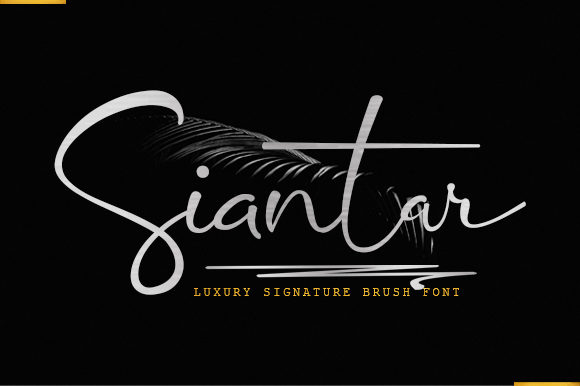
Siantar is a carefully crafted signature-style font designed to evoke elegance, warmth, and intentionality. It belongs to the broader category of script fonts—but stands apart through its refined contrast, subtle flourishes, and consistent rhythm. Unlike many decorative scripts that prioritize visual drama over usability, Siantar balances expressiveness with legibility, especially at medium to large sizes. Its letterforms feature gentle entry and exit strokes, soft terminals, and a natural flow that mimics confident, practiced handwriting—without the unevenness or idiosyncrasies that can hinder readability in branding or product applications.
What Makes Siantar Distinctive
Several design choices set Siantar apart from generic script fonts. First, its x-height is intentionally generous, improving clarity when used in labels, tags, or small-format packaging. Second, the spacing between letters has been manually adjusted—not just auto-kerned—to support cohesion across words without crowding or awkward gaps. Third, Siantar includes stylistic alternates for select characters (like the lowercase a, g, and y), allowing users to fine-tune tone: more formal for brand logos, slightly softer for handmade greeting cards or wedding stationery.
Unlike brush-script fonts that rely on texture and irregular weight variation, Siantar uses clean vector outlines with consistent stroke modulation. This makes it highly scalable—equally effective printed on fabric labels, engraved into wood, or rendered on high-resolution digital displays. Its romantic character comes not from excess ornamentation, but from proportion, balance, and restraint.
Where Siantar Fits Among Script Fonts
Script fonts fall broadly into three functional groups: calligraphic, brush-based, and formal signature. Siantar sits firmly in the last group—aligned with fonts like Bickham Script or Allura, but with notable differences. Compared to Bickham Script Pro, Siantar offers less dramatic contrast between thick and thin strokes, resulting in greater versatility at smaller sizes and reduced risk of visual fatigue in longer text blocks. In contrast to brush fonts like Pacifico or Great Vibes, Siantar avoids simulated texture or ink bleed, making it more suitable for precise applications such as laser-cut signage or embroidery digitizing.
This positioning means Siantar isn’t ideal for every script use case. It won’t replicate the energetic spontaneity of a hand-painted café menu, nor does it mimic the historical weight of copperplate engraving. Its strength lies in contemporary craftsmanship—think artisan soap labels, boutique bakery packaging, or minimalist wedding invites where sophistication and sincerity coexist.
Practical Strengths for Real-World Use
For crafters and small business owners, Siantar delivers measurable advantages. Its OpenType features include ligatures and contextual alternates that automatically improve word shape—helpful when designing monograms or short phrases. Because it’s a single-weight, non-variable font, it integrates smoothly into most design tools (Cricut Design Space, Silhouette Studio, Adobe Illustrator, Canva) without requiring special setup or compatibility workarounds.
In branding contexts, Siantar works well as a secondary or accent font—paired with a neutral sans serif like Montserrat or Lato for body text. This combination supports both emotional resonance (via Siantar) and functional clarity (via the companion font). Users report strong performance in print-on-demand environments: it scales cleanly on mugs, tote bags, and enamel pins, and holds up well when converted to vector paths for cutting machines.
One often-overlooked benefit is licensing flexibility. Siantar is typically offered under straightforward desktop and commercial licenses—no per-seat restrictions or complex usage tiers. That simplifies decision-making for solopreneurs and small studios managing multiple projects across physical and digital formats.
Tradeoffs and Situational Limitations
Like any specialized tool, Siantar has boundaries. It is not intended for body copy or interface text. Its script structure inherently limits readability below 18–20pt in print or 24px on screen—especially for readers with visual impairments or dyslexia. If your project requires extended reading (e.g., a multi-page lookbook or website hero section with paragraph-length headlines), pairing Siantar with a highly legible supporting font isn’t optional—it’s essential.
It also lacks multilingual support beyond basic Latin characters (no Cyrillic, Greek, or extended diacritics). So while it serves English, Spanish, French, and German well, it may fall short for brands targeting broader international audiences or incorporating non-Latin names or terms.
Another consideration is tone alignment. Siantar conveys warmth and intimacy—but not playfulness, authority, or technical precision. A fintech startup aiming for trust through clarity would likely find it mismatched. Similarly, a children’s toy brand seeking energy and whimsy might prefer a bolder, rounder script—or even a custom-drawn solution.
When Siantar Is the Right Choice
Siantar shines in situations where authenticity, craftsmanship, and emotional nuance matter more than neutrality or mass appeal. Consider it when:
- You’re designing packaging for small-batch goods—like herbal tea blends, candle collections, or handmade ceramics—and want typography that feels personal, not algorithmic.
- Your brand voice centers on care, tradition, or quiet confidence—rather than speed, disruption, or bold innovation.
- You need a signature element for invitations, certificates, or limited-edition prints where tactile quality and visual harmony are priorities.
- You’re working across physical media (letterpress, foil stamping, embroidery) and want predictable, clean vector output without manual cleanup.
Real-world examples include a Portland-based florist using Siantar for seasonal bouquet tags paired with a light-weight sans serif for care instructions; a Toronto-based leather goods maker applying it to debossed interior labels; or a UK-based stationery designer building a cohesive suite of wedding suites where consistency across save-the-dates, menus, and place cards matters more than stylistic variety.
When Another Option May Be More Appropriate
Siantar isn’t the default answer—and that’s by design. If your project demands:
- High legibility at small sizes: A tightly spaced, low-contrast script like Dancing Script (with its wider apertures and open counters) or a semi-script hybrid like Playlist Script may serve better.
- Expressive texture or movement: Brush fonts or variable scripts with built-in pressure simulation offer more dynamism—for posters, social banners, or editorial features.
- Multilingual or technical requirements: Fonts with extended language support (e.g., Recoleta or Sorts Mill Goudy) or robust OpenType feature sets (like FF Meta Serif with its script variants) become necessary.
- Brand scalability across diverse touchpoints: A custom-drawn logo lockup—designed specifically for your brand’s name and values—often outperforms even the strongest off-the-shelf script in long-term recognition and adaptability.
None of these alternatives invalidate Siantar—they simply reflect different goals. Choosing wisely depends less on what’s “trendy” and more on how the font functions within your specific constraints: audience expectations, production methods, brand maturity, and content hierarchy.
Making an Informed Decision
Evaluating Siantar isn’t about whether it’s “beautiful”—it is—but whether its beauty serves your purpose. Start by testing it in context: type your actual business name, tagline, and one representative product descriptor. Render it at the sizes you’ll actually use—on screen and in print. Try it alongside your current brand fonts or color palette. Does it enhance clarity—or compete with it?
Compare it not just visually, but operationally. Does it export cleanly from your design software? Does it render consistently across browsers if used in web projects (via @font-face)? Are the licensing terms aligned with your distribution model?
Finally, consider longevity. Siantar avoids fleeting trends—its proportions and spacing reflect enduring typographic principles. That makes it less likely to feel dated in two or five years, especially when used thoughtfully and sparingly. For crafters and creators building identity over time—not just for a single season—this kind of stability carries real value.