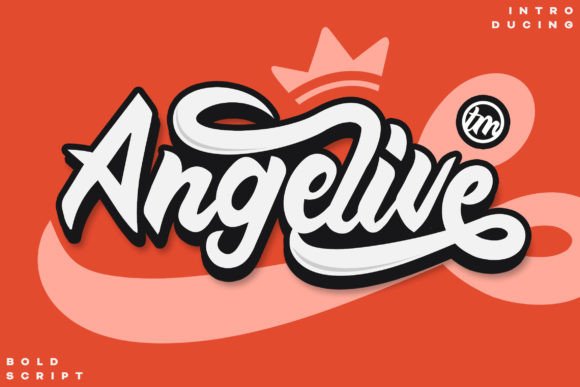
Angelive: A Friendly Handwritten Font
There’s something quietly magnetic about handwriting that feels human—not perfectly uniform, not overly stylized, but warm, intentional, and alive. Angelive captures that feeling with remarkable clarity. It’s a handwritten font designed to feel approachable and authentic, not just decorative. Its subtle irregularities—the gentle variation in stroke weight, the soft entry and exit of each letter, the slight tilt that suggests movement rather than rigidity—make it stand out in a landscape crowded with either sterile sans-serifs or overwrought script fonts.
Why Angelive Works Where Others Don’t
Many handwritten fonts sacrifice legibility for charm—or vice versa. Angelive avoids that trade-off. Its lowercase letters have generous x-heights and open counters, so even at smaller sizes (like 14–16px on screen), words remain readable without squinting. Uppercase characters carry presence without dominance, making them ideal for short headlines, logo lockups, or social media banners where tone matters as much as visibility.
What sets Angelive apart isn’t just how it looks—it’s how it behaves. It includes standard OpenType features like contextual alternates and ligatures, which means repeated letter combinations (like “tt”, “ff”, or “st”) flow naturally instead of clashing. That subtle polish helps maintain rhythm in longer text blocks—say, a blog intro, an email newsletter header, or a printed workshop handout.
Creative Uses Across Real Projects
Angelive thrives where personality and clarity need to coexist. Here’s how different creators are putting it to work:
- Bloggers & educators use Angelive for section headers and pull quotes—pairing it with a clean, neutral sans-serif (like Inter or Lato) for body text. This contrast adds warmth without sacrificing scannability. One freelance writing instructor uses it for weekly “Reflection Prompts” in her student PDFs; students consistently say those pages feel more inviting and less formal.
- Small business owners apply Angelive to product labels, packaging copy, and storefront signage—especially for artisanal goods, wellness brands, or handmade studios. A ceramicist in Portland uses it for her “Made With Care” tagline beneath each mug photo online; customers report it reinforces authenticity far better than a generic script.
- Marketers and freelancers deploy Angelive in email subject lines (as image-based text) and Instagram Story text overlays. Because its shapes are distinct but not overly ornate, it renders clearly even on small mobile screens—and stands out in crowded inboxes without looking gimmicky.
Adapting Angelive for Different Audiences
The same font can shift tone dramatically depending on context, color, spacing, and pairing. For example:
- A children’s literacy app uses Angelive at 20px for interactive letter-tracing exercises—its natural stroke direction supports early motor learning, and its friendly shape reduces intimidation for beginning readers.
- A financial advisor targeting Gen X clients uses Angelive sparingly: only in the “What You’ll Gain” section of her lead magnet PDF. Paired with charcoal gray on off-white, it signals approachability without undermining credibility.
- A wedding stationery designer layers Angelive with fine-line vector illustrations and muted watercolor textures. She avoids using it for full invitations—instead reserving it for names and dates—so the couple’s story feels personal, not generic.
Practical Tips for Stronger Results
Angelive shines brightest when used with restraint and intention. Here’s what works—and what to watch for:
- Limit usage to one or two typographic roles per project. If it’s your headline font, don’t also use it for captions or navigation. Consistency builds recognition; overuse dilutes impact.
- Test contrast carefully. Angelive performs best against light or mid-tone backgrounds. On dark mode interfaces or deep navy cards, consider lightening the font weight or switching to a high-contrast version if available—or fall back to a crisp sans-serif for readability.
- Respect line height and letter spacing. Its natural rhythm benefits from slightly increased line height (1.4–1.5x) and minimal tracking adjustments (+10–20 units in design apps). Tight spacing can make curves feel cramped; too much space breaks the handwritten illusion.
- Pair thoughtfully. Avoid other script fonts nearby. Instead, choose a neutral, well-hinted sans-serif for supporting text—something with similar x-height and low visual tension. Test how the two interact at real sizes before finalizing layouts.
Where Angelive Fits in Your Toolkit
Think of Angelive not as a “one-size-fits-all” solution, but as a deliberate choice—one you reach for when warmth, humanity, and quiet confidence matter more than neutrality or authority. It’s not the right tool for legal disclaimers, technical documentation, or data dashboards. But for a heartfelt brand manifesto, a teacher’s welcome note to parents, a boutique’s seasonal lookbook, or a nonprofit’s donor thank-you card? It bridges the gap between professional and personal in ways few fonts do.
Its vintage-inspired structure doesn’t mean it’s stuck in the past. In fact, Angelive gains relevance precisely because digital communication often feels transactional and distant. Using it signals care—not just in message, but in delivery. That’s why designers who prioritize user trust, educators building inclusive classrooms, and founders shaping mission-driven brands keep returning to it: it helps their audience feel seen, not sold to.
If you’ve been searching for a handwritten font that supports your goals without demanding attention for its own sake, Angelive is worth testing—not as decoration, but as part of your communication strategy. Try it in a single, high-impact place first: a landing page headline, a signature block in your email template, or the title of your next workshop handout. Notice how it changes the temperature of the space around it. Then decide where else that warmth might serve your work—and your audience—best.