Crack: A Color Font for Surreal, Expressive Design
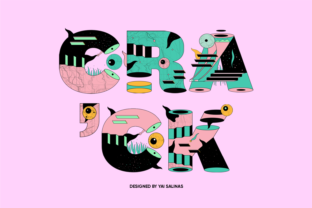
Crack is an OpenType-SVG color font designed to support visually rich, experimental typography. Unlike standard outline fonts (TTF or OTF), Crack embeds color, gradients, and layered vector graphics directly into each glyph. Its aesthetic draws from surreal spatial concepts—think fragmented perspectives, unexpected textures, and vibrant, motif-driven compositions. Each character functions as a small illustration, contributing to a cohesive yet dynamic visual language.
Crack is intended for designers who prioritize expressive impact over typographic neutrality. It works in applications that support OpenType-SVG fonts—including Adobe Photoshop, Adobe Illustrator, Silhouette Studio (version 5.0+), and Inkscape. It does not function in Cricut Design Space, as that platform lacks SVG font rendering capability. Users should verify software compatibility before purchase, especially if their workflow relies on cutting machines or legacy design tools.
Why Consider Crack?
Designers often seek typefaces that go beyond legibility to reinforce concept, mood, or narrative. Crack responds to that need by offering built-in chromatic complexity and stylistic cohesion. Its motifs—recurring shapes, tonal shifts, and spatial layering—encourage consistency across headings, posters, or digital interfaces without requiring manual recoloring or masking.
It’s particularly relevant when working on projects where typography serves as primary visual content: album art, exhibition identities, editorial features, or motion graphics thumbnails. Because each glyph renders with embedded color and detail, Crack reduces the number of manual steps needed to achieve a polished, illustrative result.
Benefits and Practical Advantages
One core benefit is efficiency in color-rich workflows. Designers using Crack avoid the time-intensive process of applying gradients, overlays, or clipping masks to standard fonts. The font handles color application at the glyph level, preserving scalability and editability within compatible software.
Another advantage is stylistic unity. Since all characters share the same underlying visual logic—color relationships, stroke treatments, and compositional rhythm—layouts maintain coherence even when mixing uppercase, lowercase, or symbols. This can simplify decision fatigue during early-stage ideation.
Crack also supports non-Latin characters and numerals with the same treatment, making it viable for multilingual headlines or symbolic systems where visual continuity matters more than linguistic coverage.
Tradeoffs and Technical Considerations
The most significant limitation is software dependency. OpenType-SVG fonts require explicit support—not just from the application, but from its version and rendering engine. For example, while Illustrator supports Crack fully, older versions of Photoshop may render glyphs as monochrome outlines unless SVG rendering is enabled in preferences. Inkscape users should confirm they’re running v1.1 or later for reliable performance.
Crack is not suitable for body text or long-form reading. Its intricate details and saturated palettes reduce readability at small sizes or low resolutions. It’s optimized for display use: headlines, logos, short quotes, or interface accents.
Additionally, because color is embedded rather than applied via CSS or fill swatches, direct global recoloring isn’t possible in most applications. Adjustments typically require editing individual glyphs or using layer-based overrides—adding complexity for users expecting full color flexibility.
When Crack Is a Strong Fit
Crack aligns well with projects where visual experimentation is central and technical constraints are understood. Examples include:
- Branding systems for creative studios, galleries, or music labels that emphasize conceptual depth over broad accessibility;
- Digital campaigns targeting audiences familiar with avant-garde or digital-native aesthetics;
- Printed materials like limited-run zines or exhibition catalogs where high-resolution output preserves fine detail;
- Educational or speculative design work exploring the boundaries of typographic form and color interaction.
In these contexts, Crack’s surreal sensibility becomes a functional asset—not just decoration. Its structure invites reinterpretation of space and hierarchy, supporting ideas about fragmentation, perception, or juxtaposition.
When Alternatives May Be More Appropriate
If your workflow depends heavily on Cricut, CorelDRAW, Affinity Designer, or Microsoft Office, Crack won’t integrate reliably. In those cases, a well-designed variable font with strong color theming—or a set of hand-drawn SVG icons paired with a neutral display typeface—may offer comparable expressiveness with broader compatibility.
For projects requiring WCAG-compliant contrast, multilingual support beyond Latin scripts, or responsive web typography, standard web fonts (WOFF2) with CSS-driven color control remain more flexible and accessible. Crack has no web-optimized variant and cannot be embedded via @font-face in standard CSS without fallback limitations.
Similarly, if your goal is subtle texture or restrained chromatic variation—rather than bold, motif-driven statements—fonts like GT America Color, Colophon Foundry’s Chromatic, or even manually layered single-color fonts may provide greater control and subtlety.
Making a Practical Decision
To determine whether Crack fits your needs, ask three questions:
- What software do you use—and which versions? Confirm SVG font support in your primary tools. Check release notes or test a free sample before purchasing.
- What’s the scale and context of your typography? If most usage is at 48pt or larger in static layouts, Crack performs well. If you need sub-24pt text, dynamic resizing, or screen-reader compatibility, it’s not appropriate.
- Does your project benefit from built-in visual logic—or require adaptability? Crack excels when its surreal motifs reinforce meaning. But if you need to shift palettes frequently, match brand guidelines exactly, or repurpose text across many formats, its fixed color model may add friction.
Reviewing the Ultimate Font Guide helps clarify how OpenType-SVG fonts differ from traditional formats—and what adjustments your workflow may need. That resource covers installation, layer management, export settings, and troubleshooting common rendering issues.
Crack is not a universal solution, nor is it meant to replace foundational typefaces. It occupies a specific niche: expressive, color-integrated display typography for designers comfortable balancing aesthetic ambition with technical awareness. Its value emerges not from versatility, but from focused intention—making it worth evaluating when your goals align with its strengths.