Edfander: A Sweet, Romantic Crafting Font
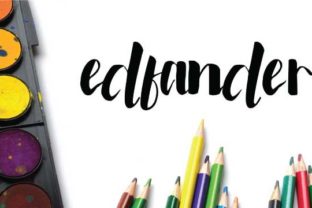
Edfander is a hand-crafted display font with delicate curves, gentle swashes, and soft contrast—designed to evoke warmth, nostalgia, and quiet elegance. It’s not a utility font for body text or data dashboards. Instead, Edfander shines where personality matters most: wedding invitations, handmade product labels, boutique packaging, journal covers, and heartfelt social posts. Its charm lies in its intentionality—not in versatility, but in emotional resonance.
Why This Font Feels Different
Unlike many modern script fonts that lean into dramatic flourishes or digital precision, Edfander balances control and imperfection. Letters connect naturally but never overwhelm. The lowercase a and g have subtle open forms; the capital S and T carry just enough weight to anchor a line without stiffness. It’s legible at 24pt on a printed tag—and expressive enough to hold attention at 80pt on a canvas tote. That narrow sweet spot makes it especially useful for projects where tone is as important as information.
For Beginners: Simplicity With Soul
If you’re just starting with design tools—or even using Canva or Google Slides—Edfander works without requiring advanced typography knowledge. You don’t need to adjust kerning manually to get pleasing results. Try pairing it with a clean sans-serif like Inter or Open Sans for contrast: Edfander for your headline (“Hand-Poured Soy Candles”), and the sans-serif for details (scent notes, burn time, care instructions). No plugins, no learning curve—just immediate warmth.
Beginners also appreciate that Edfander comes with standard OpenType features (like ligatures and alternate characters) but doesn’t demand they be used. You can install it, type, and move on—while still feeling like your work has care baked in.
For Small Business Owners & Makers
When you sell physical goods—ceramics, botanical soaps, embroidery kits, or vintage-inspired stationery—your font choice quietly signals your brand’s values. Edfander tells customers: *This was made with attention. This isn’t mass-produced.* It complements natural textures (linen, kraft paper, matte laminate) and soft color palettes (dusty rose, sage, oat, clay). One ceramicist uses Edfander for her “Made in Portland” stamp on each mug base—small, consistent, and deeply personal.
It’s also commercially licensed for unlimited use across products, websites, and marketing—no per-download fees or subscription tiers. For someone juggling inventory, shipping, and Instagram stories, that clarity matters more than flashy features.
What to Watch For
- Legibility at small sizes: Avoid using Edfander below 16pt in print or 20px on screen—especially for addresses or fine print.
- Language support: It includes Latin-based languages (English, Spanish, French, German, etc.) but not extended Cyrillic or Asian scripts.
- File format: Comes in OTF and TTF, so it works in Adobe apps, Affinity Suite, Cricut Design Space, and Silhouette Studio.
For Educators & Content Creators
Teachers designing classroom posters, homeschool planners, or printable emotion cards often seek fonts that feel inviting—not clinical. Edfander softens academic content without sacrificing clarity. A fifth-grade teacher uses it for “Growth Mindset Quote of the Week” banners; another layers it over watercolor backgrounds in digital lesson slides to reduce visual fatigue.
Bloggers and newsletter writers also find value in its tonal consistency. If your audience connects with slow living, mindful creativity, or intergenerational craft traditions, Edfander reinforces that voice before a single word is read. It doesn’t shout—it invites leaning in.
For Design Professionals & Freelancers
You’ll likely evaluate Edfander through a lens of restraint and intention. Does it serve the brief—or distract from it? It’s rarely the *only* font in a system, but often the perfect accent: a logo lockup’s tagline, a book cover’s subtitle, or the “Est. 2018” under a bakery’s monogram. Its limited character set (no full math symbols or extensive punctuation variants) means it’s best deployed where impact outweighs breadth.
One freelance designer uses Edfander exclusively for client onboarding documents—paired with a neutral serif—to signal warmth and approachability before the first meeting. Another integrates it into brand guidelines for a textile studio, specifying exact size ranges and spacing rules so interns and contractors apply it consistently.
For Hobbyists & Personal Projects
Whether you’re stitching a quilt label, designing a family recipe book, or printing a “Happy First Birthday” banner, Edfander meets you where you are. It doesn’t require expensive software—many free editors support custom fonts—and it prints cleanly on home inkjets and laser printers. Its romantic, unhurried rhythm mirrors the pace of making by hand.
One knitter uses Edfander to label yarn winders with project names (“Luna Shawl,” “Maple Mittens”). Another frames Edfander-printed quotes beside pressed flowers in shadow boxes. These aren’t commercial uses—but they’re meaningful, and Edfander honors that.
Does Edfander Fit Your Next Project?
Ask yourself:
- Is emotional tone as important as function? (e.g., a baby announcement vs. a software dashboard)
- Will this appear on physical items—tags, labels, cards, packaging—where texture and tactility matter?
- Do you want something recognizable but not overused? (It’s less common than Pacifico or Great Vibes, yet feels familiar.)
- Are you comfortable limiting its use to headlines, names, short phrases, or decorative elements?
If three or more answers are “yes,” Edfander is likely a thoughtful match—not because it’s trendy, but because it aligns with how you want people to feel when they see your work.
It won’t solve layout problems or replace strong copy. But when the right words meet the right shape—when “Hand-Gathered Herbs” curves gently across a linen sachet, or “With Love, Always” rests softly beneath a Polaroid—it adds quiet confidence to what you make.