Twas the Night Before Christmas Font
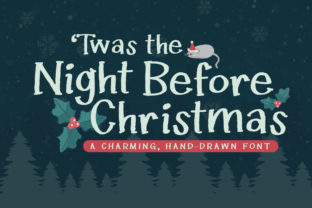
Twas the Night Before Christmas is a digitally released handwritten serif font designed to evoke the charm and irregularity of authentic pen-on-paper lettering. Despite its festive name, it is not limited to holiday-themed projects. Its defining traits—slightly uneven baseline alignment, variable stroke weight, subtle ink variation, and playful character proportions—make it suitable for contexts where warmth, personality, and approachability are priorities.
The font includes standard Latin characters, numerals, and common punctuation. It supports basic OpenType features such as ligatures and stylistic alternates, though it does not include extended language support (e.g., Cyrillic or Vietnamese) or extensive diacritic coverage. It is distributed in TrueType (.ttf) and OpenType (.otf) formats, compatible with mainstream design applications including Adobe Creative Cloud, Affinity Suite, Figma, and Canva.
Why Designers Consider Twas the Night Before Christmas
Designers often seek typefaces that convey tone quickly and effectively. Twas the Night Before Christmas stands out when the goal is to signal informality, nostalgia, or handmade authenticity. Its visual rhythm differs from rigid, geometric scripts—its letters tilt, swell, and taper organically, suggesting human effort rather than algorithmic precision.
This makes it relevant beyond seasonal work. For example, a small-batch candle brand might use it on product labels to reinforce artisanal positioning. A children’s book illustrator could apply it to chapter headings to enhance narrative whimsy. Social media designers sometimes deploy it in Instagram story text overlays where legibility at small sizes is secondary to mood and brand voice.
Practical Benefits and Realistic Tradeoffs
One benefit is versatility across non-technical use cases: it scales well in print for posters or invitations, holds up in digital mockups, and reads clearly at medium sizes (16–32 pt). Its contrast between thick and thin strokes adds visual interest without sacrificing readability in short bursts of text—such as headlines, logos, or callouts.
However, limitations exist. The font is unsuitable for long-form body text due to inconsistent letter spacing and reduced x-height, which can impair scanning efficiency. Its irregular baseline also means tight line spacing may cause visual crowding. Users should avoid using it for UI elements like buttons or navigation menus where clarity and consistency are essential.
Another consideration is licensing. While many vendors offer personal-use licenses at low cost, commercial use—including client work, merchandise, or app interfaces—typically requires an extended license. Users must verify permissions with their chosen distributor, as terms vary across marketplaces like Creative Market, MyFonts, or independent foundries.
When It Fits Well
Twas the Night Before Christmas performs best in scenarios where typographic personality outweighs functional neutrality. These include:
- Event branding: Birthday party invites, baby showers, or themed festivals where a lighthearted, hand-crafted aesthetic aligns with audience expectations.
- Small business identity: Cafés, boutiques, or craft studios aiming to emphasize local, human-scale production over corporate uniformity.
- Social media visuals: Instagram posts, Pinterest graphics, or TikTok thumbnails where brief, expressive text reinforces visual storytelling.
- Editorial accents: Magazine pull quotes, blog headers, or zine layouts where contrast with a neutral sans-serif body font creates intentional hierarchy.
When Alternatives May Be Preferable
Designers should consider alternatives if any of the following apply:
- Need for multilingual support: Projects targeting global audiences may require fonts with broader Unicode coverage. Alternatives like Amatic SC (free, Google Fonts) or Berkshire Swash offer similar warmth with wider language compatibility.
- Requirement for typographic pairing flexibility: Twas the Night Before Christmas leans heavily into its own character, making complementary pairing with other display fonts more challenging. More restrained handwritten options—such as Homemade Apple or Waiting for the Sunrise—offer subtler contrast while retaining expressiveness.
- Accessibility or screen-readability concerns: For public-facing web content where WCAG compliance matters, decorative fonts should be reserved for non-essential text only. In those cases, system fonts or accessible web fonts remain the responsible choice for primary interface text.
- Budget constraints with commercial intent: Free or open-source alternatives may better suit early-stage startups or educators needing broad usage rights without per-project licensing overhead.
Making an Informed Choice
Evaluating Twas the Night Before Christmas begins with clarifying the project’s core objective. Ask: Is the priority immediate emotional resonance—or consistent, scalable functionality? If the answer leans toward the former, and the usage falls within its technical boundaries (short text, moderate size, appropriate context), it is a viable candidate.
Test it early. Import the font into your layout tool and simulate real conditions: view it on mobile screens, check contrast against background colors, and assess how it interacts with supporting typefaces. Avoid judging solely from specimen images—those often optimize lighting, spacing, and kerning beyond typical use.
Also consider workflow integration. Some design teams rely on cloud-based tools with limited custom font upload capabilities. Confirm whether your platform supports the file format and permits embedding before committing to it for collaborative projects.
Finally, reflect on longevity. Decorative fonts can date quickly if tied too closely to trends. Twas the Night Before Christmas avoids overt trendiness through its classic serif foundation—but its kooky execution still anchors it to a specific stylistic moment. Use it where its personality serves a lasting brand attribute, not just a passing visual preference.
In summary, Twas the Night Before Christmas is a purpose-built tool—not a universal solution. Its value lies in specificity: it excels where human imperfection enhances meaning, not where precision defines success. Understanding that distinction helps designers select it intentionally, rather than by default.