Distic: A Refined Serif for Discerning Design Work
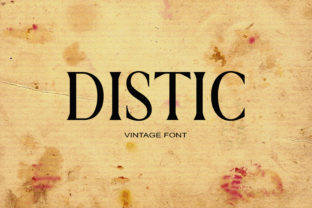
Distic is a sophisticated serif typeface designed with intention—not just aesthetics, but legibility, rhythm, and quiet authority. It doesn’t shout; it settles in. That makes it especially valuable for professionals who rely on typography to reinforce credibility, clarity, and care: publishers laying out long-form articles, educators preparing course materials, small business owners crafting brand guidelines, or freelance designers selecting text faces for client websites and print collateral. Unlike many contemporary serifs that lean heavily into either stark minimalism or nostalgic revivalism, Distic occupies a measured middle ground—timeless without being dated, structured without feeling rigid.
What Sets Distic Apart Visually and Functionally
At first glance, Distic’s elegance comes from its balanced proportions and considered contrast. Its serifs are bracketed and slightly flared—not too abrupt, not too soft—giving letters stability without heaviness. The x-height sits comfortably above average, supporting strong readability at smaller sizes, while the ascenders and descenders extend just enough to maintain vertical rhythm in dense paragraphs. Letterforms like a, e, and g feature open apertures and gentle curves, reducing visual tension in extended reading. The weight range spans from Light to Bold, each cut carefully hinted and spaced for consistent performance across devices and rendering engines.
More importantly, Distic was built with real-world constraints in mind. Its hinting and OpenType features—including discretionary ligatures, true small caps, and proportional old-style figures—are implemented thoughtfully, not as decorative afterthoughts. These aren’t flourishes you’ll only notice in a specimen sheet—they’re tools that improve typographic control in editorial layouts, financial reports, or academic manuscripts where precision matters.
Where Distic Excels in Practice
Distic performs reliably in environments where both aesthetics and function carry equal weight. In web typography, its robust hinting helps maintain shape and spacing at 16–18px body sizes—even on lower-DPI screens—without sacrificing warmth. On the printed page, its even color and consistent stroke modulation support high-fidelity reproduction in brochures, annual reports, and book interiors. One designer recently used Distic for a nonprofit’s donor newsletter: the type held up well across email clients, PDF exports, and a responsive web version, all while preserving a tone of thoughtful professionalism.
Its flexibility extends beyond medium. Pair Distic with a neutral sans-serif—like Inter or Manrope—for headings and UI labels, and the contrast feels intentional, not jarring. Use it alone in a minimalist brochure or letterhead, and it communicates restraint and confidence. It’s equally at home in a university syllabus, a boutique skincare brand’s packaging copy, or the body text of a Substack newsletter aimed at policy analysts.
Who Benefits Most—and When It Might Not Fit
Professionals who prioritize coherence over novelty tend to get the most out of Distic. Educators preparing lecture handouts appreciate how its generous counters and open forms reduce eye strain during close reading. Marketers building brand systems value its ability to scale—from tiny app interface labels (in Light or Regular) to large-format signage (in Bold)—without losing character. Freelancers often cite Distic as a “go-to serif” for client work because it avoids polarizing stylistic choices: it’s neither overly traditional nor trend-driven, making approval cycles smoother.
That said, Distic isn’t optimized for every use case. It’s not a display face—its design favors readability over impact, so it won’t command attention in large-scale advertising headlines the way a bold, high-contrast serif might. It also lacks extensive language support beyond Latin-based scripts (no Cyrillic, Greek, or extended Vietnamese glyphs), limiting its utility for global publishing projects. And while its weights are well-balanced, there’s no UltraLight or Black variant—so if your workflow demands extreme contrast between thin and heavy text layers, you’ll need to supplement with another family.
Quality, Consistency, and Long-Term Usability
The technical execution of Distic reflects careful craftsmanship. Kerning pairs are comprehensive and context-aware—especially in punctuation combinations like “f,” “fi,” “fl,” and “ffl”—which prevents awkward gaps in running text. Metrics are uniform across weights, meaning switching from Regular to Italic in a paragraph doesn’t disrupt line height or tracking. This consistency reduces manual tweaking in layout tools like Adobe InDesign or Figma, saving time without compromising output quality.
From an E-E-A-T perspective—experience, expertise, authoritativeness, trustworthiness—Distic aligns with expectations for serious communication. It signals attention to detail without calling undue attention to itself. That’s why it appears in contexts where credibility is non-negotiable: legal disclaimers, research abstracts, grant applications, and editorial bylines. It doesn’t distract; it supports. And because its design avoids fleeting trends, it’s unlikely to feel outdated in three or five years—making it a sound investment for brands and publications planning multi-year content strategies.
Practical Recommendations for Implementation
If you’re evaluating Distic for a project, start with its intended role. For body text—especially longer passages—test it at 16px on screen and 10–11pt in print, with generous line height (1.5–1.65). Its strength lies in sustained readability, not compactness. Avoid tight tracking or excessive justification; let its natural spacing breathe. In digital interfaces, pair it with a system-friendly sans for buttons and navigation—Distic works best when it’s not asked to do everything.
For branding, consider how Distic interacts with your existing voice. If your messaging leans warm and approachable, its subtle warmth complements that tone. If your brand is highly technical or data-forward, its clarity reinforces precision. But avoid forcing it into playful or youthful contexts—its elegance reads as deliberate, not casual. One small business owner found Distic effective for her architecture firm’s website but switched to a more geometric sans for social media graphics, recognizing that platform-specific expectations matter.
Finally, licensing is straightforward: Distic is available through reputable foundries with clear desktop, web, and app usage terms. There’s no variable font version yet, so if your project requires fine-grained weight or width control via CSS, plan accordingly. But for most professional workflows—print, static web, PDFs, presentations—the standard OTF/TTF files deliver predictable, high-quality results.
A Thoughtful Choice, Not a Trendy One
Distic won’t solve every typographic challenge—but it solves many quietly and well. It’s the kind of typeface that earns respect over time, not applause on first sight. If your work involves communicating complex ideas, representing an organization with integrity, or designing materials meant to last beyond a single campaign cycle, Distic offers a level of refinement that feels earned, not applied. It’s not flashy. It doesn’t chase attention. Instead, it supports understanding—cleanly, consistently, and with quiet confidence. That makes it less of a “font pick” and more of a practical decision for anyone who treats typography as part of their craft, not just decoration.