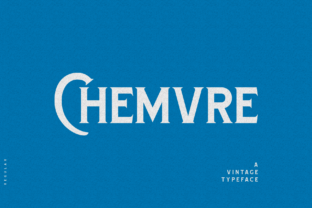
Chemvre: A Refined Serif for Timeless Typography
Chemvre is a classic serif typeface designed with intention—not as a nostalgic imitation, but as a deliberate synthesis of traditional letterform structure and contemporary readability. It carries the quiet authority of well-set text without leaning into ornate excess or rigid formality. For professionals who rely on typography to support clarity, credibility, and cohesion—whether crafting a brand identity, laying out a long-form report, or designing editorial content—Chemvre offers a consistent, adaptable voice that holds up across media and scale.
What Sets Chemvre Apart from Other Serifs
At first glance, Chemvre shares DNA with transitional serifs like Baskerville or Times New Roman: moderate contrast between thick and thin strokes, bracketed serifs, and an open, upright stance. But its distinguishing traits emerge with closer inspection. The lowercase a and g use a two-story construction—enhancing legibility in body text—while the x-height sits slightly higher than typical transitional models, improving screen readability without sacrificing elegance. Letter spacing is generous but not loose; the rhythm feels even, not mechanical. These aren’t arbitrary choices—they reflect careful optical tuning for sustained reading at 10–14 pt sizes, especially in print and high-resolution digital environments.
Unlike many modern serif revivals that prioritize stylistic novelty over function, Chemvre avoids idiosyncratic flourishes. There’s no exaggerated ink trap, no forced irregularity in stroke weight, and no experimental terminals. That restraint contributes directly to its reliability: it performs predictably across PDF exports, web rendering (with proper variable font fallbacks), and multi-platform CMS previews. Designers who’ve worked with fonts that shift character width or baseline alignment unexpectedly—especially when switching from InDesign to WordPress—will appreciate Chemvre’s consistency.
Real-World Use Cases and Practical Performance
Chemvre excels where typographic neutrality serves the message—not where the typeface itself becomes the subject. Consider these scenarios:
- Editorial publishing: A regional magazine uses Chemvre for body copy and pull quotes. Its even color and balanced rhythm reduce reader fatigue across 3,000-word features. Subtle variations in italic angle (10°, not 12°) keep emphasis clear without visual disruption.
- Brand documentation: A sustainable architecture firm selects Chemvre for project reports and client proposals. Its grounded proportions convey expertise and care—without evoking academia or bureaucracy. Paired with a clean sans-serif for headings (e.g., Inter or Founders Grotesk), it creates hierarchy without contrast overload.
- Long-form web content: An independent educator publishes weekly deep-dives on pedagogy. With proper
@font-facedeclarations andfont-display: swap, Chemvre renders legibly on iOS Safari and Android Chrome—even on mid-tier devices. Its hinting supports subpixel rendering better than some older serif fonts, reducing blur at smaller sizes.
That said, Chemvre isn’t optimized for ultra-narrow columns or extreme low-resolution displays. At under 9 pt on non-Retina screens, fine serifs can soften; for microcopy (captions, footnotes, UI labels), pairing it with a robust sans remains advisable. It also lacks extensive language support beyond Western European Latin—no Cyrillic, Greek, or extended diacritics. If your audience includes multilingual readers outside English, French, German, Spanish, and Portuguese, verify coverage before committing.
Quality, Usability, and Workflow Integration
Chemvre ships in OpenType format with standard ligatures, small caps, old-style figures, and true italics—not oblique simulations. This matters in practice: automated footnote numbering stays proportional, tabular data aligns cleanly, and all-caps headings retain typographic nuance. The font file size is modest (~180 KB for full family), minimizing impact on page load—particularly relevant for sites where typography must balance aesthetic integrity with Core Web Vitals.
For designers using Figma or Adobe Creative Cloud, Chemvre integrates smoothly. Its naming follows OpenType conventions (Chemvre-Regular, Chemvre-BoldItalic), so style linking works reliably in paragraph styles. No manual weight mapping or workaround plugins are needed. Developers will find its CSS variable font implementation stable—though the variable axis currently covers only weight (200–800), not width or optical size. That’s sufficient for most responsive needs but limits fine-grained control in highly adaptive layouts.
Who Benefits Most—and When to Look Elsewhere
Chemvre suits professionals who value understated refinement over trend-driven distinction. Freelance copy editors, nonprofit communications managers, academic publishers, and boutique branding studios often cite its “quiet confidence” as a key asset—especially when working with audiences that respond to substance over stylistic flair.
It’s less suited for projects demanding strong personality or immediate visual differentiation. A music festival poster, a Gen-Z-focused app interface, or a streetwear brand identity would likely benefit more from a humanist sans, a geometric display face, or a crafted script. Chemvre doesn’t shout. It listens, structures, and endures.
Small business owners building their first website may wonder whether Chemvre justifies licensing costs versus free alternatives like EB Garamond or Cormorant Garamond. The answer depends on usage context: if the site relies heavily on printed materials (pitch decks, service brochures, packaging), Chemvre’s tighter spacing and refined metrics often yield cleaner output than free fonts built primarily for screen use. But for a simple brochure site with minimal text, the functional difference may be marginal—and budget considerations valid.
Maintaining Consistency Over Time
Typography choices accrue meaning over time. A font used consistently across a decade of annual reports, email newsletters, and presentation decks begins to signal institutional stability. Chemvre supports this kind of continuity. Its design avoids era-specific quirks—no 1990s ink traps, no 2010s monoline austerity, no AI-generated unpredictability. It reads as intentional, not algorithmic.
That longevity extends to technical maintenance. The foundry provides regular updates addressing rendering edge cases (e.g., Firefox’s legacy font fallback behavior), and documentation is clear—not buried in marketing jargon. Support responses are timely and technically precise, a practical detail that matters when a last-minute print job hinges on correct glyph substitution.
In practice, adopting Chemvre means choosing a tool that recedes when appropriate and supports without distracting. It won’t solve weak content or poor layout—but it won’t undermine them either. For professionals who treat typography as infrastructure rather than ornament, Chemvre delivers measured, dependable performance across the full spectrum of communication needs.