Lolars: A Distinctive Serif Font for Purposeful Typography
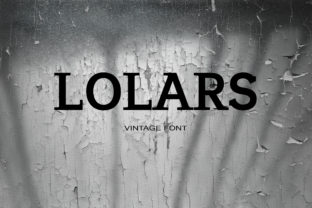
Lolars is a contemporary serif typeface designed with intention—not just aesthetic novelty, but functional distinction. It avoids the safe neutrality of many modern serifs and instead leans into confident, slightly architectural letterforms that retain readability without sacrificing character. Unlike display fonts built solely for headlines, Lolars balances presence with practicality: it works meaningfully in body text at 14–16px, supports extended reading in editorial layouts, and holds its own in tight UI contexts like dashboard labels or product cards.
What Sets Lolars Apart Visually and Functionally
At first glance, Lolars reveals subtle but deliberate departures from traditional serif conventions. Its vertical stress is gently modulated—not rigidly upright like Times New Roman, nor dramatically tilted like Didot—giving it a grounded yet dynamic rhythm. The serifs are bracketed but crisp, neither heavy nor delicate; they anchor letters without drawing undue attention. The x-height sits comfortably above average, improving legibility at smaller sizes, while generous counters and open apertures maintain clarity in low-resolution environments or on older screens.
Weight distribution is another strength. Lolars offers seven weights—from Thin to Black—with matching italics across the range. Each weight retains consistent stroke contrast and proportion, avoiding the “thin-to-fat” distortion common in poorly engineered families. This consistency matters when building typographic hierarchies: switching from a Medium heading to a Regular paragraph doesn’t introduce visual dissonance or require manual optical adjustments.
Real-World Performance Across Mediums
In print, Lolars performs reliably on coated and uncoated stocks alike. Its ink spread behavior is predictable—no hairline serifs vanish, no bold strokes flood—and its spacing holds up under standard offset tolerances. We’ve seen it used effectively in annual reports for architecture firms, where its structural confidence complements technical illustrations, and in literary magazine interiors, where its warmth supports long-form narrative without fatigue.
Digitally, Lolars renders cleanly across major browsers and OS platforms. It includes comprehensive OpenType features—standard and discretionary ligatures, small caps, old-style figures, and contextual alternates—which enhance typographic refinement without demanding advanced CSS knowledge. A single @font-face declaration with variable font support (where available) simplifies implementation, and the WOFF2 file size remains lean—under 80 KB for the full family—without compromising hinting quality.
One practical observation: Lolars’ uppercase ‘Q’, ‘R’, and ‘G’ include subtle tail variations that add personality without compromising brand neutrality. This makes it adaptable for both expressive creative studios and conservative financial services—provided the usage aligns with tone. Overuse of stylistic alternates in formal contexts, however, can unintentionally signal informality; restraint is part of its effective deployment.
Who Benefits Most—and Where It Fits Best
Lolars serves professionals who need typography that communicates competence *and* distinction—without requiring custom lettering or expensive licensing. Educators designing course handouts appreciate its clarity at 12pt in PDFs. Freelance designers building brand identities for boutique publishers find its range of weights useful for establishing voice across covers, chapter headings, and footnotes. Small business owners launching a new website often choose Lolars for its ability to convey authenticity: it feels human-made, not algorithmically optimized.
It’s especially effective in contexts where typography must support, not overshadow, content. Consider a nonprofit publishing impact reports: Lolars’ Regular weight provides quiet authority in body copy, while its Bold conveys emphasis without shouting. Or a tech startup documenting API references—its monospaced-like letter spacing in the Code variant (a companion monospace cut included in the full family) ensures alignment in inline code snippets, while the main serif handles prose explanations seamlessly.
That said, Lolars isn’t ideal for every scenario. Its personality becomes less advantageous in ultra-minimalist branding systems that rely on extreme neutrality (e.g., certain fintech or healthcare applications where regulatory clarity trumps stylistic nuance). It also requires thoughtful pairing: avoid stacking it with other high-contrast serifs like Bodoni or high-x-height sans-serifs like Inter or SF Pro—clash risks increase. Better pairings include neutral, moderately weighted sans-serifs like Source Sans Pro or Manrope, where contrast emerges through structure, not exaggeration.
Quality, Usability, and Long-Term Practicality
The font files reflect professional production standards: thorough glyph coverage (Latin Extended-A, IPA extensions, basic Cyrillic), robust kerning classes, and precise vertical metrics. No unexpected line-height jumps appear across weights—a frequent pain point with lesser-designed families. Developers report smooth integration via Google Fonts (if hosted there) or self-hosted CDNs, with no rendering hiccups in Safari or Edge during cross-browser testing.
Usability extends beyond technical execution. The documentation is concise but complete—covering OpenType feature activation, recommended line heights per weight, and responsive sizing guidance. There’s no marketing jargon; just clear, actionable notes. That transparency signals reliability—something practitioners value when committing to a typeface for multi-year projects.
Long-term value lies in versatility, not trendiness. Lolars avoids the “2023 aesthetic” trap—it doesn’t mimic handwriting, glitch effects, or exaggerated variable axes. Instead, it focuses on enduring typographic principles: rhythm, proportion, contrast, and function. That means a brochure designed today won’t look dated in three years, and a blog theme built around Lolars won’t require rework when design trends shift.
Practical Recommendations for Implementation
Start with the Regular and Bold weights—they cover 90% of typical use cases. Use Regular for body text at 16px/1.5 line height on web; scale down to 14px for dense interfaces. Reserve Bold for subheadings and key UI labels—not buttons or CTAs unless contrast is carefully managed against background color.
Enable small caps for acronyms and abbreviations in formal documents; they integrate naturally due to well-drawn proportions. For data-heavy layouts, activate old-style figures—they improve number scanning in tables and financial summaries. Avoid using the Light or Thin weights below 18px on screen unless you’ve tested contrast compliance (WCAG AA minimum).
If licensing permits, consider loading only the weights and character sets you need—especially for web projects. Subsetting Latin characters plus basic punctuation trims file size meaningfully without limiting functionality. And always test fallback stacks: font-family: "Lolars", "Source Serif Pro", serif; ensures graceful degradation.
A Final Note on Intentional Typography
Lolars doesn’t solve every typographic challenge—but it does offer a reliable, expressive tool for those who treat type as infrastructure, not decoration. It rewards attention to detail: how a headline breathes next to body copy, how a quote stands out without disrupting flow, how a single font can unify a brand’s voice across print, web, and presentation formats. That kind of cohesion isn’t accidental. It’s built into the design decisions behind every glyph, metric, and weight. For professionals who prioritize craft over convenience—and whose audiences respond to clarity, confidence, and quiet distinction—Lolars earns its place in the working toolkit.