Hern: Timeless Elegance in Every Letter
When a design calls for quiet confidence, understated authority, or a whisper of nostalgia—Hern often answers. More than just another serif typeface, Hern is a deliberate return to clarity and craftsmanship. Its clean lines, balanced proportions, and gentle contrast between thick and thin strokes give it a classic presence that feels both familiar and refreshingly intentional. Whether you're refreshing a brand identity, typesetting a boutique newsletter, or designing packaging for a small-batch coffee roaster, Hern offers a grounded, human-centered typographic voice.
What Makes Hern Distinctive?
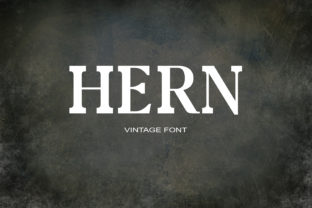
Hern isn’t trying to dazzle with ornamentation. Instead, it leans into refined simplicity. Its serif terminals are modest—not bracketed like traditional old-style fonts nor sharply geometric like modern serifs—but softly tapered, lending warmth without sacrificing structure. The x-height is generous enough for comfortable reading at smaller sizes, while the ascenders and descenders extend just far enough to ensure rhythm and legibility in longer passages.
Unlike many revivalist serifs, Hern avoids historical mimicry. It doesn’t replicate Garamond’s calligraphic flair or Bodoni’s dramatic contrast. Instead, it synthesizes mid-century typographic sensibility with contemporary usability—making it equally at home on a letterpress business card and a responsive web layout.
Core Characteristics at a Glance
- Serif style: Low-contrast, unbracketed serifs with subtle flaring
- Letterforms: Open counters, even spacing, and consistent stroke modulation
- Optical balance: Designed for both print and screen—no awkward hinting or rendering surprises
- Personality: Authoritative yet approachable; traditional without feeling dated
Where Hern Shines—and Where It Might Not Fit
Hern excels where intentionality matters more than immediacy. It’s not built for high-speed digital banners or attention-grabbing social media ads. But in contexts where tone, trust, and texture carry weight—Hern becomes a silent collaborator.
Real-World Applications
- Branding for artisanal and heritage-focused businesses — Think craft distilleries, independent bookshops, or ceramic studios. Hern’s quiet confidence reinforces authenticity without shouting.
- Editorial design — From literary magazines to annual reports, its readability across weights (light, regular, medium, bold) supports hierarchy without visual fatigue.
- Invitations and stationery — Wedding suites, gallery opening announcements, or boutique hotel welcome letters benefit from Hern’s tactile, almost hand-set quality—even when digitally printed.
- Web typography for long-form content — Paired thoughtfully (e.g., Hern for headings + a neutral sans-serif for body text), it adds gravitas to blogs, portfolios, and service pages without compromising accessibility.
That said, Hern isn’t a universal solution. Its restrained energy means it can feel “too calm” in fast-paced, youth-oriented, or highly playful contexts—like gaming interfaces, children’s apps, or energetic food delivery branding. If your project demands exuberance, kinetic movement, or maximalist expression, Hern may recede where you need emphasis.
Who Benefits Most from Using Hern?
Creatives who value intention over trend—graphic designers, typographers, and art directors—often reach for Hern when they want typography to support narrative rather than dominate it. Its versatility across weights and its strong italic (with true cursive rhythm, not just slanted roman) make it adaptable without losing cohesion.
Small business owners appreciate how Hern conveys care and consistency. A local bakery using Hern on its chalkboard menu, packaging, and Instagram bio creates a unified impression—not because everything looks identical, but because everything feels *of a piece*. That kind of subtle alignment builds recognition faster than flashy fonts ever could.
Writers and publishers find Hern especially effective for printed matter. Its ink traps are subtly optimized, its letterfit avoids crowding in tight columns, and its punctuation marks (especially the elegant ampersand and quotation marks) add finishing polish without distraction.
Practical Considerations Before You Choose Hern
Before committing, ask yourself three questions:
- Does my project prioritize clarity and longevity over novelty? Hern rewards patience—it grows more resonant the longer it’s seen, not the faster it’s scanned.
- Will it be used across multiple formats? Hern performs reliably in PDFs, CSS
@font-facedeclarations, and desktop publishing software—but always test rendering on older Android devices or legacy email clients if those are part of your distribution plan. - Do I have control over line length and leading? Like most well-proportioned serifs, Hern thrives with thoughtful vertical rhythm. In cramped UIs or narrow mobile columns, consider using it only for headlines or short labels—not dense paragraphs.
Also worth noting: Hern includes full Latin-1 support, basic OpenType features (ligatures, small caps, old-style figures), and carefully crafted punctuation. It does not include extensive language coverage (e.g., Cyrillic or extended Vietnamese diacritics), so multilingual publishing teams should verify glyph availability early.
Pairing Hern Thoughtfully
Typography is relational—and Hern’s strength lies in how gracefully it shares space. Its low contrast and open forms mean it pairs best with companions that offer complementary contrast, not competition.
For print and editorial use, try Hern regular with Freight Text or FF Meta Serif for body copy—both share its humanist warmth but offer distinct voice and texture. For digital interfaces, pair Hern medium headings with a neutral, highly legible sans like Inter or Manrope, ensuring adequate font-weight differentiation (e.g., Hern 500 + Inter 400).
Avoid pairing Hern with overly decorative or high-contrast fonts—like Didot or Blackletter revivals—unless you’re aiming for deliberate dissonance (e.g., an avant-garde art zine). Even then, limit such combinations to single-use accents, not systemic hierarchy.
Why Hern Endures in a Fast-Moving Design World
In an era of algorithmically generated fonts and AI-assisted layouts, Hern stands out precisely because it was made by people, for people—not trained on datasets, but shaped by decades of observation, iteration, and respect for how letters live in the world.
Its usefulness isn’t tied to a moment. You won’t see “Hern-inspired” trends come and go. Instead, you’ll notice it quietly anchoring projects that last—brand identities that age well, books that remain readable decades later, websites whose typography feels as considered in 2034 as it did in 2024.
That durability isn’t accidental. It’s baked into the spacing, the stress angles, the way the ‘g’ sits on the baseline, the subtle curve of the ‘S’. These aren’t flourishes—they’re functional decisions rooted in how eyes move, how hands hold paper, how light falls across ink.
A Final Thought for Your Next Project
If you’re evaluating Hern for your work, don’t ask, “Does this look cool?” Ask instead: “Does this help my audience understand, trust, and remember?” When the answer is yes—when Hern helps a reader linger on a sentence, makes a client pause before clicking “buy,” or gives a visitor the quiet sense that “this was made with care”—you’ll know it wasn’t just chosen. It was chosen well.
Because great typography, like great design, isn’t about being seen first—it’s about being felt, remembered, and returned to. And in that quiet, enduring space, Hern belongs.